Friday, January 31, 2020

THE MARRIAGE PROCESS IN ISLAM


THE MARRIAGE PROCESS IN ISLAM


The first thing we should look for when marrying is how committed the person is to Islam. Prophet Muhammad (sallallahu alayhi was sallam) said,
"A woman is normally sought as a wife for her wealth, beauty, nobility, or religiousness (adherence to Islam), but choose a religious woman and you will prosper. " (Muslim) And he said, "A woman is married for four things, i.e., her wealth, her family status, her beauty and her religion. You should marry the religious woman (otherwise) you will be a loser. "(Bukhari) And he said,
"The whole world is a provision, and the best object of benefit of the world is the pious woman. 
The same holds true when looking for a husband, as the Messenger of Allah (sallallahu alayhi was sallam) said, 
"When someone with whose religion and character you are satisfied asks to marry your daughter, comply with his request. If you do not do so, there will be corruption and great evil on earth
Of course, both parties have to agree to marry one another and they can not be forced to marry one another. The Messenger of Allah (sallallahu alayhi was sallam) said, "A woman whom has been previously married has more right concerning herself than her guardian, and a virgin’s consent must be asked about herself…"
Rules of Al-Khutbah (Request to marry a woman and the acceptance of the proposal)
The man has permission to see her face before agreeing to marry as the Messenger of Allah (sallallahu alayhi was sallam) said, "Go and look at her (the woman you are considering marrying) because this will help your time together to be strengthened."
After a man and woman have agreed to marry, they have to remember that the man is still not her mahram (men prohibited to her, including her father, brothers, sons, maternal and paternal uncles, and nephews). This means they can not still deal with one another as partners in any way (such as shaking hands, gazing at one another, being alone together, going out together, etc.), or go out with one another as we see people in the west doing. Prophet Muhammad (sallallahu alayhi was sallam) said, "Whoever believes in Allah and the Last Day, let him not have a private audience with a woman without her mahram. 
The Wedding Ceremony (Nikaah)
Components
1 – Consent: ‘Aishah(R) asked Prophet Muhammad (sallallahu alayhi was sallam) if women must be asked for their permission of marriage. Prophet Muhammad (sallallahu alayhi was sallam) replied, "Yes. " She said, ‘The virgin is asked for her permission but she gets shy. Prophet Muhammad (sallallahu alayhi was sallam) said, "Her silence is her permission.
2 – The Wallee (Woman’s Guardian): Prophet Muhammad (sallallahu alayhi was sallam) said, "There is no nikaah except with a wallee. 
3 – Two Witnesses: Prophet Muhammad (sallallahu alayhi was sallam) said, "There is no marriage except with a wallee and trustworthy witnesses. Also, "There is no marriage except with a wallee and two witnesses. 
4 – The Mahr (Dowry): Allah says (what means): "And give to the women their dowry with a good heart, but if they out of their own good pleasure remit any part of it to you, take it and enjoy it without fear of any harm. " (Al-Nisa4:4) The mahr can be of any amount, Prophet Muhammad (sallallahu alayhi was sallam) said, "Look for one even if it was an iron ring. 
The woman is not obliged to give the man anything at the time of the wedding, as is done in some cultures.
Acts to be Avoided
We should be careful to not act as the disbelievers do regarding their mixing of men and women, wearing tuxedos and white wedding gowns, exchanging rings, kissing in public, etc. Prophet Muhammad (sallallahu alayhi was sallam) said, "Whoever resembles a people is one of them. " (Abu Dawood)
After the Wedding
Supporting One’s Wife
The man is responsible for providing for his wife, as Allah says (what means), "Let the wealthy man spend according to his means; and let the man whose provisions are restricted spend according to what Allah has given him. Allah does not burden a soul beyond what He has given it, and Allah will grant ease after a hardship. " (Al-Talaq65:7)
Islam even gives women the right to take secretly money from their husbands if the husbands are not providing for them. Hind, the wife of Abu Sufyan, came to Prophet Muhammad (sallallahu alayhi was sallam) and said, "O Messenger of Allah, Abu Sufyan is a stingy man and does not give me and my children enough provisions except when I take something from him with out his knowledge." Prophet Muhammad (sallallahu alayhi was sallam) said, "Take what is reasonably sufficient for you and your children. " (Bukhari and Muslim)
Educating One’s Family
Since the man has put in the position of providing for his family, he must also provide them with the proper Islamic education to keep them from the hellfire. Allah says (what means), "O you who believe! Save yourselves and your families from a fire whose fuel is men and stones (that were worshipped), over it are appointed angels stern and severe, who disobey not the Commands they receive from Allah, but do that which they are commanded. " (Al-Tahrim66:6)
Both the husband and wife should make sure their home is a place where Allah is remembered and His Commandments are reflected and acted upon. Prophet Muhammad (sallallahu alayhi was sallam) said, "The similitude of a home in which Allah is remembered and a home in which He is not is like the living and the dead. " (Muslim)
The Wife Obeying Her Husband
A woman must obey her husband as long as he does not tell her to perform any haraam(unlawful) acts. Allah says (what means), "…the righteous women are devoutly obedient, and guard in absence what Allah would have then guard. " (Al-Nisa4:34)
Kind Treatment To One’s Wife
Just because Allah has given men a position of authority does not give them the right to abuse it. They have to treat their wives in the best manner. Allah says (what means), "Live with them honorably. " (Al-Nisa4:19) Prophet Muhammad (sallallahu alayhi was sallam) said, "The believer with the most complete faith is the one with the best character, and the best of them are those whom treat their women the best. " (Tirmidhi)
We can see from the seerah (biography) of Prophet Muhammad (sallallahu alayhi was sallam) that he would help his wives with housework and would engage in games with them as well.

THINGS THAT MADE THE PROPHET (PBUH) ANGRY


THINGS THAT MADE THE PROPHET (PBUH) ANGRY


We mentioned earlier that the Prophet (peace be upon him) never got angry for anything personal. No matter what unbelievers said about him, leveling any false accusations against him, he would always control himself, showing no sign of overreaction. Indeed, he kept his cool in all situations. However, if some violation of the limits God has ordered to be observed, the Prophet (peace be upon him) could be very angry, and his anger showed in his face.
The contrast between the two situations is clear. If the matter were personal, he (peace be upon him) would tolerate it without difficulty. His self-control ensured that he would never overreact. He was certain that even his worst enemies realized that he always told the truth. But he could not tolerate that what God has ordered should be deliberately violated. His anger in such situations was visible, but he still expressed himself in decent language, never allowing himself to utter a word that was unworthy of a messenger delivering God’s message to mankind. We have several reports of situations that made him angry, and we will look at these.
 The Prophet (peace be upon him) chose a place where he went out at night to pray. Some men saw him doing that and they prayed with him. They came every night to do that. One night, the Prophet did not come out to join them. They started to make some noises, like little coughs, and then they raised their voices, and even threw pebbles at his door. He came out to them angry and said: “Look you people! You continued doing what you did until I thought it might be made obligatory for you. Pray in your own home, because the best prayer a person can offer is that he offers at home, except for obligatory prayers.” 
What angered the Prophet (peace be upon him) in this incident is that his companions tried every means to get him to come out to lead them in night prayer, which is not an obligatory one. Some of them resorted to impolite means, first raising their voices and then throwing some pebbles at his door. We need to remember that some of the Prophet’s companions were uncultivated Bedouins who lacked polite manners, until Islam gave them the best manners people could have.
They were insisting on doing a voluntary worship in a particular way. This is wrong because it imposes a duty where there is none. Hence the Prophet (peace be upon him) told them that he feared that this night prayer would become obligatory to them. And if it were made obligatory, it would have applied to all generations of Muslims. Thus, their action would have committed them and others to more than what God wished to assign to them as worship duty.
The Prophet (peace be upon him) also told them to pray at home, saying that this is the best prayer, except for obligatory prayer that is much better offered with the congregation in the mosque. Offering voluntary prayer at home is better for several reasons. The first is that prayer gives light to the place where it is offered. If obligatory prayer is offered at the mosque with the congregation, then the proper way to ensure that the light of prayer and worship spreads in our homes is to offer the Sunnah and voluntary prayer at home.
Another very important reason is that when voluntary prayer is offered at home, it is more sincere. This is not to say that when offered in the mosque it is not sincere, but there is certainly no element of show off when we offer voluntary prayer in the privacy of our own homes. We may mention here the incident when one person testified to the fine character of another person in front of Umar (may Allah be pleased with him), the second caliph. Umar (may Allah be pleased with him) asked him the basis of his knowledge, mentioning three ways of knowing a person well.
These are being his next-door neighbor, traveling with him or having regular financial dealings. When the man answered in the negative to all three, Umar said to him: “Perhaps you are speaking highly of him because you might have seen him in the mosque reading the Qur’an?” When the man answered this question in the affirmative, Umar said to him: “You may go now. You do not really know the man.” So, it is e asy to gain a reputation of piety when one offers voluntary worship in the mosque. Hence, the Prophet tells us that the best such prayer is that which is offered at home.
A further reason is that one provides a good example for one’s children and other family members to follow. It will encourage them to offer voluntary prayers, which strengthens their faith and increases their reward.
The Prophet (peace be upon him) might get angry at something said or done by one of his companions, which suggests the violation of God’s law. Zayd ibn Khalid reports: “A man asked the Prophet about what one might find in the street, without knowing its owner. What to do with it. The Prophet said to him: ‘Publicize it for a year, and then make sure to know its description and spend it. Should its owner come up, give it back to him.’ The man said: ‘What about a lost sheep?’ The Prophet (peace be upon him) said: ‘It belongs to you, your brother or the wolf.’ The man further asked: ‘What about a lost camel?’ The Prophet’s face was reddened with anger at this question, then he said to the man: ‘What do you want with it? It has its own hoofs and drink until its owner finds it.’” (Related by Al-Bukhari, Muslim, Abu Dawood, Al-Tirmidhi and Ibn Majah).
This Hadith gives details of the rulings concerning lost articles or animals and what to do with them. However, it tells us that the Prophet (peace be upon him) was angry when asked about a lost camel. There is a good reason for his anger. The first thing the Hadith tells is that if one picks up a lost article, he should publicize the fact for a year, so that if the owner comes back looking for it, he would know where to find it. After a year the person who found it may sell it and spend its price, either using the price himself or giving it to charity, but he continues to be responsible for it. If the owner turns up after a year, the one who found it must give him the price he sold it for, unless he had given it away to charity and the owner agrees to his action. If he does not agree, he has to refund it to him. He will certainly ea rn the reward of his charity.
If it is a sheep or a similar animal that cannot defend itself, or is bound to fall prey to beasts, then one can slaughter it for food, or look after it, or sell it. If the owner turns up, he compensates him or gives it back. But if it is a camel or a similar animal, such as a horse, then there is little danger that it would come to much harm. It should be left alone until its owner finds it.
The Prophet’s anger was due to the implied suggestion in the question that the one who finds a camel could do with it what is done with a sheep. This is an attitude of a person keen on taking an easy gain. The Prophet (peace be upon him) points out to the man that a lost camel is unlikely to harm itself or to be in any danger. It can tolerate being without water for a long time. Hence, it is better left alone.

The Story of Zam Zam water

The Story of Zam Zam water
For a period of time, Prophet Ibrahim resided with his wife Sarah in Palestine. At 70 years of age, Sarah was an infertile old lady who was so keen to see her 86 years old husband Prophet Ibrahim become a father. For that reason, she offered him Hajar her maid (female slave) whom he accepted. By the Will of Allah, Hajar became pregnant with Prophet Ibrahim’s son Isma^il who also became a prophet and was honoured to be the grandfather of Prophet Muhammad may Allah’s blessings and peace be upon them all.
Prophet Ibrahim was delighted to have a child and so was his wife Sarah. After a period of time Prophet Ibrahim went with his baby son Isma^il and his mother Hajar to Makkah.
Dear brothers and sisters in Islam,
Observe, in what I am about to tell you, how reliant upon and submissive to Allah Prophet Ibrahim ^alayhis-salam was.
Prophet Ibrahim ^alayhis-salam had left his two dear ones, Hajar and Isma^il in a barren area in Makkah. Makkah at the time was completely isolated with no evident buildings or people living there since there was no water for survival.
There, Prophet Ibrahim left them with only a bag of dates and a leather bag filled with water.  When Hajar noticed that Prophet Ibrahim was about to make his way back to Palestine alone, she followed him saying: “O Ibrahim, are we to be left alone in this valley with no water, or food or companions?” To that Prophet Ibrahim did not respond. So she kept posing the question repeatedly without getting an answer from Prophet Ibrahim, therefore, she said, “Did Allah order you to do this?”  He replied, “Yes.”  Upon hearing this, eloquently and with a complete reliance on Allah she said: “Then we will not be lost.”
Following the order of Allah, Prophet Ibrahim peace be upon him left and when he was a fair distance away from Hajar and their son, he looked back at the Sacred House (Al-Bayt) and as mentioned in Ayah 37 of Surat Ibrahim, he made the following supplication to Allah:
“O Lord! I have settled some of my offspring in a barren valley by Your Sacred House so that they would perform the Prayer. O Lord, make the hearts of some people yearn towards them and provide them with fruits for which they would give thanks”.
Hajar, the mother of Isma^il settled with her son where Ibrahim peace be upon him left them. She breast-fed him and drank from the water that Ibrahim had left for them. This water eventually ran out as the water container dried up. Consequently, Hajar became thirsty, and so did her son who started crying and became unsettled due to his extreme thirst. Hajar hated seeing him in that state and she set forth looking for water. As-Safa being the mountain closest to her, she climbed it and looked down at the valley to see if she could find anyone to assist her. She found no one and so she descended from the mountain until she reached the valley.
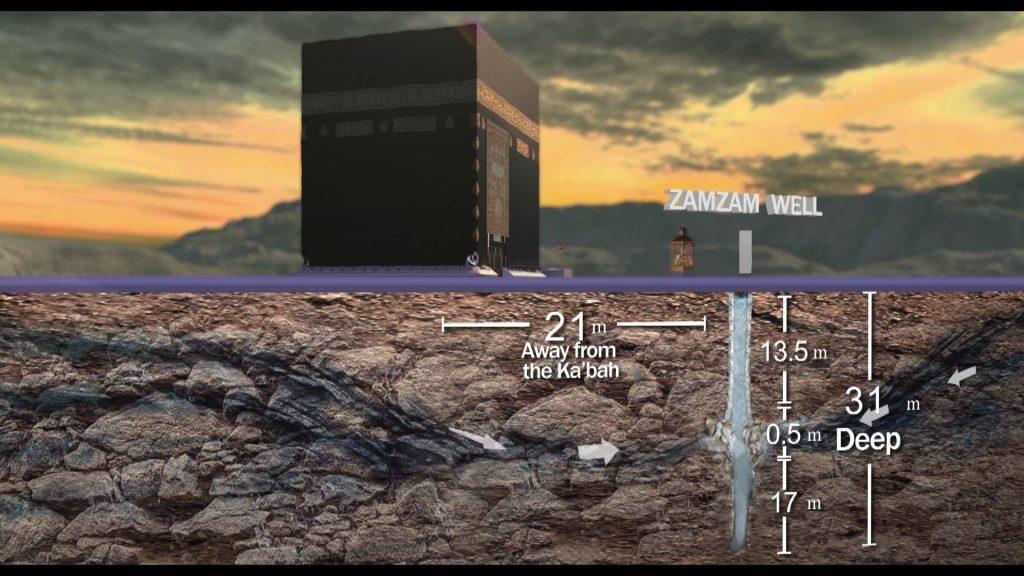
Then she climbed Al-Marwah Mountain in keeping her search for water but to no avail. She went back to As-Safa then back again to Al-Marwah for many times. On her last arrival to Al-Marwah, she heard a voice which prompted her to call out: “Help, if you can”. There was Angel Jibril peace be upon him, who hit the ground with his wing until fresh and pure water emerged. That became known as Zamzam water. The mother of Isma^il gathered the water with her hands and collected it in her container while it was springing out. Jibril said: “Do not fear loss, for there is a sacred House here which will be built by this child and his father”, meaning Isma^il and his father Ibrahim peace be upon them both.
Hajar drank from Zamzam water quenching her thirst and breast-fed her son Isma^il. She thanked Allah, the One who endows countless bounties upon His slaves.
O Allah, we ask you to grant us Al-Hajj and Al-^Umrah and the visit of the Prophet peace be upon him, and we ask You Allah to make us amongst those who drink from his honourable hand at the Hawd. Amin.

THE PUBLIC CALL OF THE PROPHET MUHAMMAD (PBUH)


THE PUBLIC CALL OF THE PROPHET MUHAMMAD (PBUH)


After three years of Prophethood, fearlessly calling to and teaching people Islam with skilled tactics, God revealed to Prophet Muhammad, peace and blessings be upon him, to make a public call. God revealed ayah 214 of ash-Shu^ara’ in which God ordered Prophet Muhammad (peace and blessings of Allah be upon him)to warn his relatives, calling them to Islam.
Prophet Muhammad (peace and blessings of Allah be upon him) went on the top of as-Safa, a mountain in Makkah, and called the different clans by their names. They came in a hurry. The Prophet said, “If I were to tell you that there was an enemy ready to attack you, would you believe me?”
 They said, “Yes. We never experienced except truthfulness from you.” He said, “I am a warner to you of a very severe torture (if you do not hold the proper belief).” Abu Lahab, one of the uncles of the Prophet, cursed him. He was mad, thinking that our Prophet was wasting their time and trying to destroy their lifestyle. Shortly after that incident, God revealed the surah called al-Masad in which it is mentioned that both Abu Lahab and his wife will receive severe torture in Hellfire.
The news of this surah reached the wife of Abu Lahab, Umm Jamil, who was a very wicked woman. When Umm Jamil heard the surah, she came to the area of the Ka^bah with stones in her hand. She addressed Abu Bakr threatening to harm the Prophet by saying, “I heard your friend has dispraised me, and I will show him.” Abu Bakr asked her, “Do you see anyone with me?” She said, “No. Are you mocking me?” She continued to dispraise the Prophet, who was sitting next to Abu Bakr. After she left, the Messenger of God told his Companion, “Some angels blocked her from seeing me and saved me from her evil.”
Once, one of the leaders of the blasphemers, ^Uqbah Ibn Abi Mu^ayt, saw the Prophet praying next to the Ka^bah. He took the clothes of the Prophet and strangled the Prophet severely. Abu Bakr came and pushed him away from the Prophet and said, “Do you kill a man because he says: God is my Lord?”
One of the main leaders of the blasphemers was a man called Abu Jahl. This was the name that the Muslims gave to him meaning “the very ignorant person.” When our Prophet started calling people to Islam, Abu Jahl became a big enemy of the Muslims, mocking and torturing them. Once, Abu Jahl urged his cohort to put the stinking innards of a camel on the back of our Prophet while he was prostrating in prayer. It was done, while Abu Jahl and his friends mocked our Prophet. Brave, little Fatimah, the daughter of our Prophet, removed that filth off her father, who completed his prayer. Fatimah (may Allah be pleased with him) was only about ten years old at the time.
The Prophet (peace and blessings of Allah be upon him) carried out the order of God to call his relatives as well as other tribes to Islam. He degraded their idols, which angered them. They all agreed to consider him as their enemy. The uncle of the Prophet, Abu Talib, protected him from the harm of Quraysh’s blasphemers and others. This angered the idol worshippers of Makkah and a group of their leaders said to Abu Talib, “Your nephew has cussed our idols and slandered our religion. Either you stop him or you give him up to us. After all, you follow the same religion that we do.” Abu Talib talked to them gently and they left him.
The Prophet (peace and blessings of Allah be upon him) continued with his mission and the hatred of the idolaters to the Prophet increased. They went again to Abu Talib and said, “You have an age, status, and honor among us. We had asked you to stop your nephew, but you did not. We swear by God, we will not be patient with his cussing our fathers and idols. Either you stop him or we will fight him and you, until one side is victorious.”
Abu Talib found it hard for himself to be away from his people and his heart was neither inclined to embrace Islam nor to let the Messenger of God down. However, he said to the Prophet, “O nephew, your people told me so and so. Avoid getting yourself and me killed. Do not put on my shoulders that which I cannot bear.” The Messenger of God thought that his uncle was letting him down and pulling out his support for him. He said, “O uncle, I swear by God, were they to put the sun in my right hand and the moon in my left to leave out calling to Islam, I would not do so until God makes Islam victorious, or I die while conveying it.” Then the Prophet wept. His uncle called him and said, “Come back my nephew. Say what you like. I swear by God that I will not give you up.” When Quraysh realized that Abu Talib was not going to give up his nephew, they increased their persecution and torture of the Muslims under their hands.
The Messenger of God (peace and blessings of Allah be upon him) used to address the people saying, “O people, God orders you to worship Him and not to associate anything with Him.’ Abu Lahab would walk behind him and say, “This man wants you to leave the religion of your fathers.”
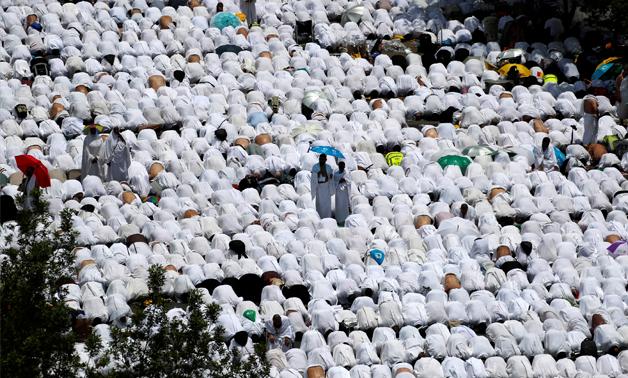
The blasphemers met at their Hajj season to agree on something to say about the Prophet. (They would do some of the actions that we do nowadays in Hajj but they did it with their wrong belief. Hajj had been done by Prophet Isma^il, but through the years its performance had become perverted). Some said, “We will say he is a fortune teller.” Others wanted to say he was insane; and others wanted to say he was a magician. Others wanted to say that he was a poet. However, they all agreed that he was not any of that. Finally, they agreed to say that he brought a religion that separates between the person and his father, brother, tribe, and his wife.
As a result of warning against the Prophet (peace and blessings of Allah be upon him), he became very famous among the various Arab tribes. Thus, many of his own people were against him at that time. Yet, he was trying to save them from Hellfire, by God’s Will. An Arab tribe at his time believed that God had married an elite woman of jinn and that they gave birth to angels. Of course the truth, which our Prophet declared, was that God was not a man, and He never took a wife. God had no children. Additionally, angels were neither male nor female. Our Prophet was unshakeable in his mission to spread the truth about God and His attributes. The threats of misguided people did not scare him.
After making the public call, two brave men who were respected in Makkah became Muslim: Hamzah (the Prophet’s uncle) and ^Umar Ibnul-Khattab (may Allah be pleased with him). ^Umar was set on killing the Prophet after the public call. Yet, after he read some verses of the Qur’an that his Muslim sister had, he went to our Prophet. God changed ^Umar’s heart, and he professed his Islam to our Prophet (peace and blessings of Allah be upon him).

HADITHS ABOUT HAJ


HADITHS ABOUT HAJ


The Messenger of Allah (ﷺ) said, "(The superstructure of) Islam is based on five (pillars), testifying the fact that La ilaha illallah wa anna Muhammad-ar-Rasul-ullah [there is no true god except Allah, and Muhammad ((ﷺ)) is the Messenger of Allah], establishing As- Salat (the prayers), paying Zakat (poor due), the pilgrimage to the House [of Allah (Ka'bah)], and the Saum (fasting) during the month of Ramadan." [Al-Bukhari and Muslim].
Abu Hurairah (May Allah be pleased with him) reported:
The Messenger of Allah (ﷺ) delivered a Khutbah and said, "O people! Hajj (pilgrimage to the House of Allah) has been made incumbent upon you, so perform Hajj." A man inquired: "O Messenger of Allah, is it prescribed every year?" He (ﷺ) remained silent till the man repeated it thrice. Then he (ﷺ) said, "Had I replied in the affirmative, it would have surely become obligatory, and you would not have been able to fulfill it." Afterwards he said, "Do not ask me so long as I do not impose anything upon you, because those who were before you were destroyed on account of their frequent questioning and their disagreement with their Prophets. So when I order you to do something, do it as far as you can; and when I forbid you from doing anything, eschew it." [Muslim].
Abu Hurairah (May Allah be pleased with him) reported:
The Prophet (ﷺ) was asked: "Which deed is the best?" He (ﷺ) replied, "Faith in Allah and His Messenger." Then he was asked: "What is next?" He replied, "Jihad (holy fighting) in the Cause of Allah." Then he was asked, "What is after that?" He (ﷺ) replied, "Hajj Mabrur (an accepted pilgrimage)." [Al-Bukhari and Muslim].
Abu Hurairah (May Allah be pleased with him) reported:
The Messenger of Allah (ﷺ) said, "Whoever performs Hajj (pilgrimage) and does not have sexual relations (with his wife), nor commits sin, nor disputes unjustly (during Hajj), then he returns from Hajj as pure and free from sins as on the day on which his mother gave birth to him." [Al-Bukhari and Muslim].
Abu Hurairah (May Allah be pleased with him) reported:
The Messenger of Allah (ﷺ) said, "(The performance of) 'Umrah is an expiation for the sins committed between it and the previous 'Umrah; and the reward of Hajj Mabrur (i.e., one accepted) is nothing but Jannah." [Al-Bukhari and Muslim].
'Aishah (May Allah be pleased with her) reported:
I said: "O Messenger of Allah! We consider Jihad as the best deed, should we not then go for Jihad?" The Messenger of Allah (ﷺ) said, "The best Jihad for you women is Hajj Mabrur (i.e., one accepted by Allah)." [Al-Bukhari].
'Aishah (May Allah be pleased with her) reported:
The Messenger of Allah (ﷺ) said, "There is no day on which Allah sets free more people from Hell than He does on the Day of 'Arafah." [Muslim].
Ibn 'Abbas (May Allah be pleased with them) reported:
The Prophet (ﷺ) said, "(The performance of) 'Umrah during Ramadan is equal to Hajj (pilgrimage)." Or said, "Equal to the performance of Hajj with me." [Al-Bukhari and Muslim].
Ibn 'Abbas (May Allah be pleased with them) reported:
A woman came to the Messenger of Allah (ﷺ) and said, "Allah's obligation upon His slaves has become obligatory on my father in his old age. My father is very old and incapable of riding. May I perform Hajj on his behalf?" He (ﷺ) said, "Yes." [Al-Bukhari and Muslim].
Laqit bin 'Amir (May Allah be pleased with him) reported:
I came to the Prophet (ﷺ) and said: "My father is a very old man and does not have strength to perform Hajj (pilgrimage) or 'Umrah or to undertake the journey." The Prophet (ﷺ) said, "Perform Hajj and 'Umrah on behalf of your father." [Abu Dawud and At-

Alhamdulillah- O Allah Thank you


Alhamdulillah- O Allah Thank you

What is the meaning of alhamdulillah? It is usually translated as, 'All praise is due to Allah.' Which has led many of us to use the phrase, Alhamdulillah wa shukr Allah.' But this is very incorrect because alhamdulillah is actually is a word of praise that includes within it a greater gratitude or shukr for what Allah has ordained, and as Muslims, we are supposed to use it when we are presented with that which appears good and with that which appears bad.But, in the reality of our lives, what is alhamdulillah? What does it truly mean? Is just a word on our lips? Or is it a genuine feeling in our hearts? Someone once told me that alhamdulillah means when you don't have something you need or want,

 you are content with your fate; when you have a limited quantity of that thing, you are content with it, and you try to share it, and when you have a lot, you are content, and you are searching for ways to share it more. In other words, no matter what your condition, you are grateful to Allah for that condition. It is a recognition that all that Allah has given us or taken from us is the best for us.

In practical terms, what does this mean. There is an example that I like to use when I speak of Allah's Knowledge and Power over us that may help illustrate my meaning. When I was a new Muslimah, I had the most beautiful white cat. I loved this cat very much. It used to wake me up for fajr, and I considered it a great blessing in my life.

The problem, however, was that my landlady did not allow pets in my apartment. This meant that the cat's presence had to remain a secret. One day, the landlady called and told me that she was coming that day to do the periodic spraying for roaches. I knew I had to hide the cat, but in such a way that he did not come home again from where I put him, so I decided to take him to a friend's house for the day. So, I grabbed my cat, and took him to my car.

As I was driving to her house, the cat went crazy. He was clawing at me and at one point attached himself to the back of my head. I guess he had never been in a car before, and was terrified. He thought this was the worst thing that could have possibly happened to him. Now, I had information that the cat did not. I knew that my actions were actually a salvation for him. If my landlady had found the cat, we would have both been homeless. But, of course, there was no way for the cat to know this. It was beyond his comprehension.

What is the point here? Well, Allah places us in many situations that are similar. He provides us with circumstances that in our limited understanding and perception we find to be disastrous. We can react to them as the cat did, with fear and pure animal instincts, or we can recognize Allah's Wisdom and Superior Knowledge, and be content with the situation because we have faith that it is somehow better for us to experience this. To be content with it, would be to live out alhamdulillah. It would show our acceptance of Allah's Power over us, our recognition of His care for us, and our gratitude for His Mercy.

For Allah says,

"...This is of the grace of my Lord that He may try me whether I am grateful or ungrateful; and whoever is grateful, he is grateful only for his own soul, and whoever is ungrateful, then surely my Lord is Self-sufficient, Honored.

Allah had given us so much, and our duty as Muslims is to be grateful for those many blessings. Ibin Abid -Dunya mentioned that Dawud asked Allah, "What is the least of your blessings?" Allah revealed to him to take a breath. Dawud did so, and Allah told him, This is the least of my blessings on you." (I found this hadith in Patience and Gratitude by Ibin Qayim Al Jawziyyah, p. 70).

Imagine that, taking a breath as a blessing from Allah. It is an involuntary action that basically sustains us. So much is involved, not only from the physiological perspective but also from the conditions that must exist on the earth to create the perfect combination of elements for us to breathe.

One breath of a human involves the workings of all of his internal organs as well as the fact that we have plants that take our carbon dioxide and convert them back to oxygen which is essential for us to continue breathing. The processes involved are so many and so detailed that they can not be covered except by an entire science course which will just outline the basics. Allahu Akbar.

We must remember that all that we possess is from Allah. But we can not stop there. We must also recognize that that which we do not possess is also a blessing from Allah. We must recognize the Power and Knowledge of Allah by being grateful for His Blessings. Things are not always as they seem. We may condiser something to be bad, horrible or disastrous, when in actuality it is purely Allah's blessing on us. Remember the story of Musa and Al Khadir:

'Moses got up to deliver a sermon before Bani Israel and he was asked, 'Who is the most learned person among the people?' Moses replied, 'I (am the most learned).' Allah then admonished Moses for he did not ascribe all knowledge to Allah only (Then) came the Divine Inspiration:-- 'Yes, one of Our slaves at the junction of the two seas is more learned than you.'

Moses said, 'O my Lord ! How can meet him?' Allah said, 'Take a fish in a basket and wherever the fish is lost, follow it (you will find him at that place). So Moses set out along with his attendant Yusha' bin Nun, and they carried with them a fish till they reached a rock and rested there. Moses put his head down and slept.

(Sufyan, a sub-narrator said that somebody other than 'Amr said) 'At the rock there was a water spring called 'Al-Hayat' and none came in touch with its water but became alive. So some of the water of that spring fell over that fish, so it moved and slipped out of the basket and entered the sea. From Sahih Bukhari: Volume 6, Book 60, Number 251: Narrated by Said bin Jubair:

When they had passed on (some distance), Moses said to his attendant: "Bring us our early meal; truly we have suffered much fatigue at this (stage of) our journey." He replied: "Sawest thou (what happened) when we betook ourselves to the rock? I did indeed forget (about) the Fish: none but Satan made me forget to tell (you) about it: it took its course through the sea in a marvellous way!" Moses said: "That was what we were seeking after:

" So they went back on their footsteps, following (the path they had come). So they found one of Our servants, on whom We had bestowed Mercy from Ourselves and whom We had taught knowledge from Our own Presence. Moses said to him: "May I follow thee, on the footing that thou teach me something of the (Higher) Truth which thou hast been taught?"

(The other) said: "Verily thou wilt not be able to have patience with me!" "And how canst thou have patience about things about which thy understanding is not complete?" He said: If Allah pleases, you will find me patient and I shall not disobey you in any matter He said: If you would follow me, then do not question me about any thing until I myself speak to you about it So they went (their way) until when they embarked in the boat he made a hole in it.

 (Musa) said: Have you made a hole in it to drown its inmates? Certainly you have done a grievous thing. He said: Did I not say that you will not be able to have patience with me? He said: Blame me not for what I forgot, and do not constrain me to a difficult thing in my affair. So they went on until, when they met a boy, he slew him. (Musa) said: Have you slain an innocent person otherwise than for manslaughter? Certainly you have done an evil thing. He said: Did I not say to you that you will not be able to have patience with me? He said:

If I ask you about anything after this, keep me not in your company; indeed you shall have (then) found an excuse in my case. So they went on until when they came to the people of a town, they asked them for food, but they refused to entertain them as guests. Then they found in it a wall which was on the point of falling, so he put it into a right state. (Musa) said: If you had pleased, you might certainly have taken a recompense for it. He said:

This shall be separation between me and you; now I will inform you of the significance of that with which you could not have patience. As for the boat, it belonged to (some) poor men who worked on the river and I wished that I should damage it, and there was behind them a king who seized every boat by force. And as for the boy, his parents were believers and we feared lest he should make disobedience and ingratitude to come upon them:

So we desired that their Lord might give them in his place one better than him in purity and nearer to having compassion. And as for the wall, it belonged to two orphan boys in the city, and there was beneath it a treasure belonging to them, and their father was a righteous man; so your Lord desired that they should attain their maturity and take out their treasure, a mercy from your Lord, and I did not do it of my own accord. This is the significance of that with which you could not have patience. (18:60-82).

Musa was not patient in learning the meanings of what he had seen. But he learned a very important leasson, one we should take to heart. Allah's Knowledge is so beyond ours, even when he gives one of us a bit more that the other, we can not see easily beyond the superficial meanings of the events of life, and we must trust Allah's judgement and be grateful for the favors He confers on us. We must say and feel alhamdulillah. We must make it a true part of our lives. The foundation of our faith.

Such a simple word, but it carries so much in it. It tells of our faith in Allah. It shows how we must accept the qadr of Allah in times we consider good and times we consider bad, not turning our backs on Allah, like the people of the boat, when Allah gives us what we want, but being grateful for whatever occurs good or bad.

Allah says,

He it is Who makes you travel by land and sea; until when you are in the ships, and they sail on with them in a pleasant breeze, and they rejoice, a violent wind overtakes them and the billows surge in on them from all sides, and they become certain that they are encompassed about, they pray to Allah, being sincere to Him in obedience: If Thou dost deliver us from this, we will most certainly be of the grateful ones. But when He delivers them, lo! they are unjustly rebellious in the earth. O men! your rebellion is against your own souls-- provision (only) of this world's life-- then to Us shall be your return, so We will inform you of what you did. (10:22-23)

 We can not only say alhamdulillah, and be grateful slaves when we are blessed with what we want, we must also remain grateful when we are hit by the worst of disasters. In my humble opinion, the worst loss this nation ever had, was the death of our beloved prophet, Muhammad. We recognize his humanity, but it was when he departed us that the splits began in the ummah. The blessing of unity, one he was not granted by his Lord, is a terrible black mark on the ummah. Yet, we must have faith that in some way, this is beneficial to us. In some way there is a blessing, and for it we must say, alhamdulillah.

Allah says,

And Muhammad is no more than a messenger; the messengers have already passed away before him; if then he dies or is killed will you turn back upon your heels? And whoever turns back upon his heels, he will by no means do harm to Allah in the least and Allah will reward the grateful. (3:144)

Our beloved prophet dies, and we are to be grateful? To the human mind and heart this is incomprehensible, but this is where our faith comes in. If we truly trust in Allah's Judgement, we must be grateful. Alhamdulillah rabil Al Amiin for all that He brings to us. We must accept the bitter with the sweet because we believe in Allah, we trust in Him and we know that He is the Best of Judges, the Most Wise, and His plan for us is the Fairest, Most Merciful and Best for us in this life and in the hereafter.

Allah says,

Therefore remember Me, I will remember you, and be thankful to Me, and do not be ungrateful to Me.

And

And hold fast, all together, by the rope which Allah (stretches out for you), and be not divided among yourselves; and remember with gratitude Allah's favour on you; for ye were enemies and He joined your hearts in love, so that by His Grace, ye became brethren; and ye were on the brink of the pit of Fire, and He saved you from it. Thus doth Allah make His Signs clear to you: That ye may be guided.

And

O ye who believe! Eat of the good things that We have provided for you, and be grateful to Allah, if it is Him ye worship.

Also, let us remember to be extra grateful, for , " When anything came to the Prophet (peace_be_upon_him) which caused pleasure (or, by which he was made glad), he prostrated himself in gratitude to Allah." Narrated by AbuBakrah. Sunan Abu Dawud: Book 14, Number 2768. What ever is for us is for us. We can not avoid our Qadr.

Our control comes in how we handle it when it comes. Ali Ibin Abi Talib saw adiyy Ibin Hatim looking sorrowful, and so he asked him, "Why are you so sad, O Adiyy?" Adiyy replied, "How can I not be in such a state when both of my sons have been killed and my eye gouged out?"

So Ali said to him, "O Adiyy, whoever is content with the decree of Allah will surely experience it and be rewarded for it; and whoever is not content with the decree of Allah will surely experience it, and Allah will make his actions worthless." (Purification of the Soul, p119).

We will experience what Allah has ordained for us. But will it bring us blessings or only misery. We must accept the decree of Allah, be content with it and be grateful for it, because we know what Allah has decreed is the best for us. This is the implementation of alhamdulillah.

Now, the blessings of alhamdulillah in itself are many. Below I will show a few of these many blessings:

Narrated Ali: Fatima went to the Prophet complaining about the bad effect of the stone hand-mill on her hand. She heard that the Prophet had received a few slave girls. But (when she came there) she did not find him, so she mentioned her problem to 'Aisha. When the Prophet came, 'Aisha informed him about that. 'Ali added, "So the Prophet came to us when we had gone to bed. We wanted to get up (on his arrival) but he said, 'Stay where you are."

Then he came and sat between me and her and I felt the coldness of his feet on my abdomen. He said, "Shall I direct you to something better than what you have requested? When you go to bed say 'Subhan Allah' thirty-three times, 'Alhamdulillah' thirty three times, and Allahu Akbar' thirty four times, for that is better for you than a servant." Sahih Bukhari: Volume 7, Book 64, Number 274.

Narrated AbuMalik al-Ash'ari: The Messenger of Allah (peace_be_upon_him) said: Cleanliness is half of faith and Alhamdulillah (Praise be to Allah) fills the scale, and SubhanAllah (Glory be to Allah) and Alhamdulillah (Praise be to Allah) fill up what is between the heavens and the earth, and prayer is a light, and charity is proof (of one's faith) and endurance is a brightness and the Qur'an is a proof on your behalf or against you. All men go out early in the morning and sell themselves, thereby setting themselves free or destroying themselves.

Narrated AbuDharr: Some of the people from among the companions of the Apostle of Allah (peace_be_upon_him) said to him: Messenger of Allah, the rich have taken away (all the) reward. They observe prayer as we do, they keep the fasts as we keep them, and they give sadaqah from their surplus riches. Upon this he (the Holy Prophet) said:

 Has Allah not prescribed for you (a course) by following which you can (also) do sadaqah? In every declaration of the glorification of Allah (i.e. saying SubhanAllah) there is a sadaqah, every Takbir (i.e. saying AllahuAkbar) is a sadaqah, every praise of Him (saying Alhamdulillah) is a sadaqah, every declaration that He is One (La ilaha illallah) is sadaqah, enjoining of good is a sadaqah,

forbidding of that which is evil is a Sadaqah, and in man's sexual intercourse (with his wife) there is a Sadaqah. They (the companions) said: Messenger of Allah, is there reward for him who satisfies his sexual passion among us? He said: Tell me, if he were to devote it to something forbidden, would it not be a sin on his part? Similarly, if he were to devote it to something lawful, he should have a reward. Sahih Muslim:

Narrated Samurah ibn Jundab: The dearest words to Allah are four: SubhanAllah (Hallowed be Allah), Alhamdulillah (Praise be to Allah), La ilaha illallah (There is no god but Allah), and AllahuAkbar (God is the Greatest)...

Narrated Anas ibn Malik: Allah's Apostle (peace_be_upon_him) said: Allah is pleased with His servant who says: Alhamdulillah while taking a morsel of food and while drinking.

Narrated Abu Huraira: Some poor people came to the Prophet and said, "The wealthy people will get higher grades and will have permanent enjoyment and they pray like us and fast as we do. They have more money by which they perform the Hajj, and 'Umra; fight and struggle in Allah's Cause and give in charity.

" The Prophet said, "Shall I not tell you a thing upon which if you acted you would catch up with those who have surpassed you? Nobody would overtake you and you would be better than the people amongst whom you live except those who would do the same. Say "Sub-han-al-lah", "Alhamdu-lillah" and "Allahu Akbar" thirty three times each after every (compulsory) prayer." We differed and some of us said that we should say,

"Subhan-al-lah" thirty three times and "Alhamdu lillah" thirty three times and "Allahu Akbar" thirty four times. I went to the Prophet who said, "Say, "Subhan-al-lah" and "Alhamdu lillah" and "Allahu Akbar" all together for thirty three times." Sahih Bukhari: Volume 1,

I pray that Allah give us the faith, poatience and gratitude to impliment alhamdulillah into ours lives as true pious slaves of Allah. May He forgive us guide us and provide us with the best in this life and the next. Ameen

Makkah-The Holy City In Islam


Makkah-The Holy City In Islam


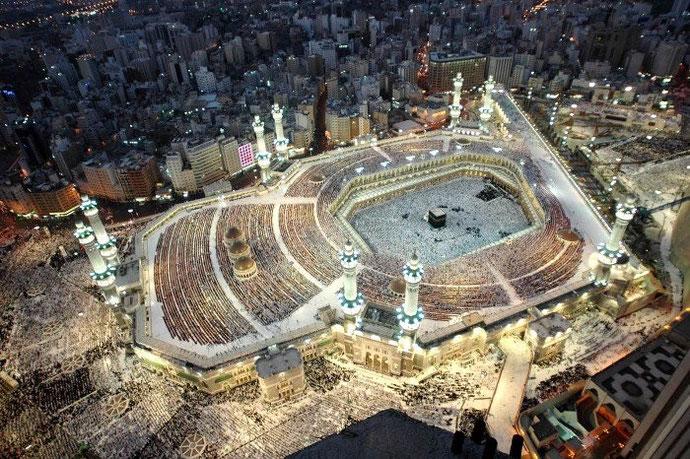
The holiest city of Islam, Mecca is in western Saudi Arabia. Prophet of Islam, Hazrat Muhammad SAW was born in this city. Millions from the globe visit Mecca for the Hajj(pilgrimage). Kaaba, the sacred is also in this city and it is in Masjid al-Haram.  


How Quran Name Makkah

  • Makkah
  • Bakkah
  • Al-Balad
  • Al-Qaryah
  • Ummul-Qura

Quranic Verses

In Surah Al-Imran, Allah (ﷻ) states: “Verily, the first House (of worship) appointed for mankind was that at Bakkah (Makkah), full of blessing, and guidance for Al-Alamin (mankind and jinn).” (Quran, 3:96)
When the Muslims conquered Makkah. The Prophet (ﷺ) said, “Allah had made this city sacred the day He created the heavens and the earth and its sanctity shall remain until the Day of Qiyamah (Day of Judgement). Its thorns cannot be broken, its animals cannot be harmed and things fallen on its ground cannot be picked up unless with the intention of returning it to its owner or making public announcements (to locate the owner). It is also forbidden to cut the grass that (naturally) grows here.” (Muslim)
History goes back to 2000 BC when the Kaaba was first built by Ibrahim AS. He with his son Hazrat e Ismaeel AS built the first Kaaba in the city of Mecca. 
Prophet SAW was born In mecca in 571 AD. After the time of Ibrahim AS, the majority of Arabs started worshiping idols and before the time of Muhammad SAW, it was full of idols, approximately there were about 360 idols were there including Laat, Manat, and Uzza. When a prophet of Islam conquered Mecca in 630 all the idols were thrown away from Kaaba and these idols were also broken down. That was a new beginning for the life of Arabs.
The prophet of Islam also united the tribes in Mecca. It was done by diplomacy and where needed He used force as well. It was the end of long-running wars between Arab tribes. Muhammad SAW even after conquering Mecca, did not stay long there but returned to Madina. 

Zamzam Well


Another significance of the city of Mecca is, at the time of Hazrat Ismaeel, the famous Well of Zamzam also sprouted from the land of Mecca when the water was direly needed. This is the holiest water until now. The Muslim pilgrims every year bring this water for their beloved ones for different reasons. It is thought to be the purest water on earth. 

Kaaba

Hazrat Ibraham AS raised the foundations and said “Our Lord, accept this from us. You are the Hearer, the Omniscient.” (Quran, 2:127)
Another significant reason for why the mecca is one of the holiest city in Islam is the Kaaba. It is the House of God, all Muslims offer their Islamic obligation namaz by keeping their faces towards Kaaba. It is covered with gold-embroidered black fabric and it is 40 cube style building.
The hadith of Sahih Bukhari is worth adding here about the construction of the Kaaba, it will definitely help our readers.
It is mentioned in Sahih Bukhari, Ibrahim AS left his wife and Ismaeel on a mountainous place and stayed away for a long time, as hadith tells us, that,
“Then Abraham stayed away from them for a period as long as ALLAH wished, and called on them afterward. He saw Ishmael under a tree near Zamzam, sharpening his arrows. When he saw Abraham, he rose up to welcome him (and they greeted each other as a father does with his son, or a son does with his father). Abraham said,
 ‘O Ishmael! ALLAH has given me an order.’ Ishmael said, ‘Do what your Lord has ordered you to do.’ Abraham asked, ‘Will you help me?’ Ishmael said, ‘I will help you.’ Abraham said, ‘ALLAH has ordered me to build a house here,’ pointing to a small hill higher than the land surrounding it.’ The Prophet added, ‘Then they raised the foundations of the House’;” i.e., the Ka’ba.
There is a long tale about the city, and we cannot include all here, the long in short is Mecca is in all Muslims hearts because of the affiliation of prophet Muhammad SAW to this city and because of the affiliation of the early Islam towards this city of Makkah. May Allah keep this city blessed forever.
Let us conclude our discussion with a hadith of Prophet Muhammad SAW about the holy city.

Hadith about the city of Mecca

Abdullah ibn ‘Adi reported: I saw the Messenger of Allah, peace, and blessings be upon him, while he was standing near Mecca and saying, “By Allah, you are the best and most beloved land to Allah. Had I not been driven away from you, I would not have left you.” (Sunan al-Tirmidhī 3925)